
Description
A Complete Infrastructure for Safe, Defensible, and Sustainable Nursing Delegation – Downloadable Manuals
Many provider agencies struggle to recruit and retain delegating nurses.
Not because nurses lack skill or willingness—but because too often, the structure needed to support safe delegation simply isn’t there.
Delegating nurses are routinely expected to:
- assume full professional accountability,
- manage multiple sites and staff,
- respond to incidents and changes in condition,
- and withstand audits and investigations—
without a clear, standardized system that protects compliance, quality, and the nurse themselves.
When delegation is informal, inconsistent, or poorly documented, nurses carry disproportionate risk.
Over time, this leads to burnout, refusal to delegate, or turnover.
Why Structure Matters
Nursing delegation requires:
- clear authority and limits,
- consistent assessment standards,
- defined supervision expectations,
- and complete, defensible documentation.
The Academy Integrated Delegated Nursing Governance & Oversight System was designed specifically to provide that structure—so delegation is safe, compliant, and sustainable for both the agency and the nurse.
Two Manuals. One Integrated System.
This system consists of two manuals that must be used together. Each serves a distinct role. Neither is sufficient on its own.
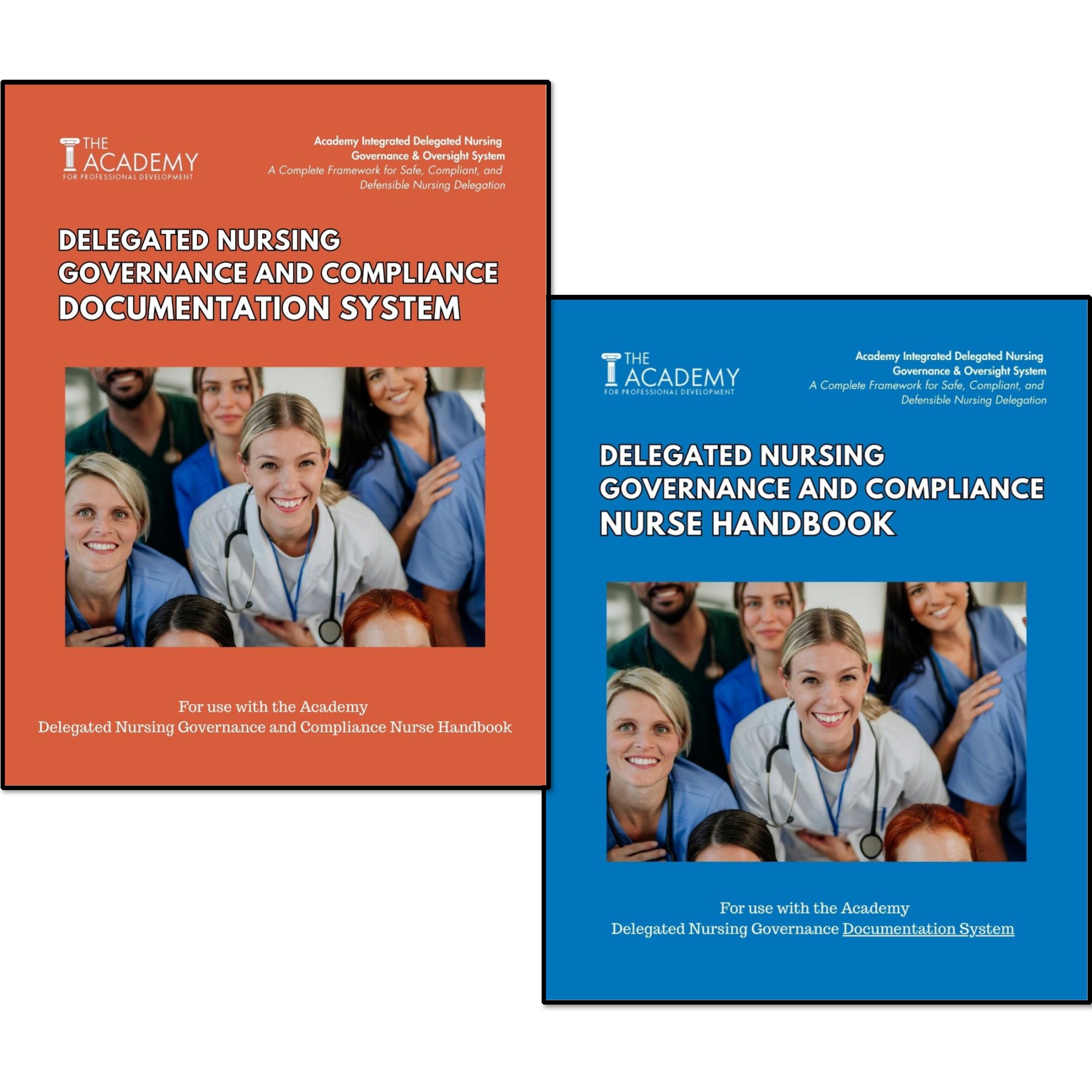
Manual 1: Delegated Nursing Governance & Compliance Nurse Handbook
Supports the Nurse’s Clinical Authority and Professional Judgment
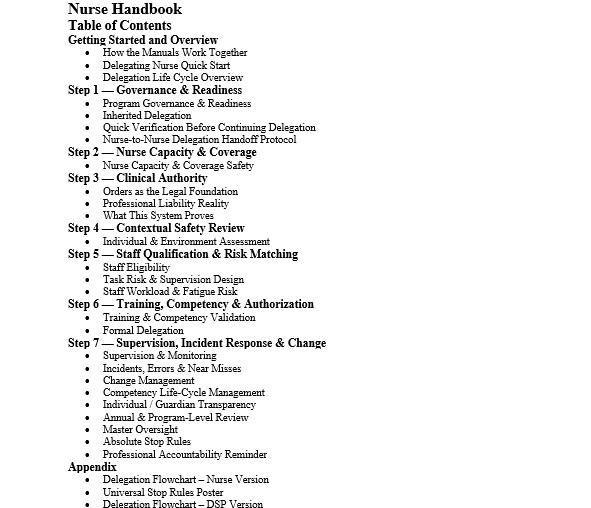
This handbook establishes the governance framework that protects the delegating nurse by clearly defining:
- when delegation is appropriate—and when it is not,
- which tasks may never be delegated,
- required assessments and supervision levels,
- stop rules, change triggers, and revocation authority,
- nurse-to-nurse handoff expectations, and
- non-transferable accountability.
This manual gives nurses structure, clarity, and defensible authority, rather than placing the burden entirely on individual discretion.
Manual 2: Delegated Nursing Governance Documentation System
Provides the Proof That Protects the Nurse and the Organization
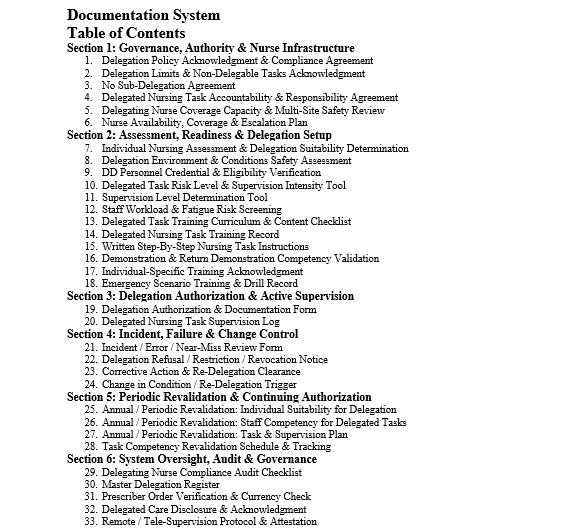
The Documentation System operationalizes the handbook by converting every delegation requirement into written, auditable evidence.
It documents:
- governance acknowledgments and scope limits,
- individual and environment suitability,
- staff eligibility and competency validation,
- formal written delegation authorization,
- supervision, escalation, and monitoring,
- incident response and corrective action,
- revalidation, annual review, and oversight tracking.
It protects nurses from being left unsupported when questions, audits, or investigations arise.
Why Agencies Lose Delegating Nurses—and How This System Helps
Delegating nurses leave when:
- expectations are unclear,
- documentation is inconsistent,
- supervision capacity is unrealistic,
- accountability is assumed but not supported,
- and systems rely on memory instead of structure.
This integrated system helps agencies:
- create delegation programs nurses are willing to step into,
- reduce professional risk exposure,
- standardize delegation across programs and sites,
- improve consistency, safety, and quality of care,
- and retain nurses by supporting—not isolating—them.
Required Use Together
These manuals are intentionally designed to function as one system.
- The Nurse Handbook governs decisions
- The Documentation System proves execution
Who This System Is For
✔ Provider agencies struggling to recruit or retain delegating nurses
✔ Nurses responsible for delegation across multiple settings
✔ Organizations seeking audit-ready delegation practices
✔ Leadership teams committed to sustainable, compliant care delivery
What This System Ultimately Does
This system exists to:
- protect individuals receiving services,
- protect direct support staff from unsafe expectations,
- protect the nurse’s professional license,
- protect the organization,
- and create delegation programs that nurses can realistically support long-term.
Delegation is not convenience.
Delegation is controlled clinical extension—supported by structure.